
Posts tonen met het label Wisdom Books. Alle posts tonen

The Essential Seyyed Hossein Nasr

The Essential Seyyed Hossein Nasr

Edited by William C. Chittick
Foreword by Huston Smith

Seyyed Hossein Nasr is a world-renowned scholar on Islam, Sufism, and the Perennial Philosophy, and is the author of over fifty books and five hundred articles on topics ranging from comparative religion to traditional Islamic philosophy, cosmology, art, ecology, and mysticism. The Essential Seyyed Hossein Nasr is an anthology of 21 of his most representative essays, including several rare articles which have not been easily available in the U.S., carefully selected and edited by William C. Chittick, a former student of Prof. Nasr and leading scholar of Islam and Sufism.

Source: Worldwisdom.com


Pontifical and Promethean Man (Chapter 17)

The concept of man as the pontiff, pontifex, or bridge between Heaven and earth, which is the traditional view of the anthropos, lies at the antipode of the modern conception of man, which envisages him as the Promethean earthly creature who has rebelled against Heaven and tried to appropriate the role of the Divinity for himself. Pontifical man, who, in the sense used here, is none other than traditional man, lives in a world which has both an Origin and a Center. He lives in full awareness of the Origin which contains his own perfection and whose primordial purity and wholeness he seeks to emulate, recapture, and transmit. He also lives on a circle of whose Center he is always aware and which he seeks to reach in his life, thought, and actions. Pontifical man is the reflection of the Center on the periphery and the echo of the Origin in later cycles of time and generations of history. He is the vicegerent of God (khalifat Allah) on earth, to use the Islamic term, responsible to God for his actions, and the custodian and protector of the earth of which he is given dominion on the condition that he remain faithful to himself as the central terrestrial figure created in the “form of God,” a theomorphic being living in this world but created for eternity. Pontifical man is aware of his role as intermediary between Heaven and earth and his entelechy as lying beyond the terrestrial domain over which he is allowed to rule provided he remains aware of the transient nature of his own journey on earth. Such a man lives in awareness of a spiritual reality which transcends him and yet which is none other than his own inner nature against which he cannot rebel, save by paying the price of separation from all that he is and all that he should wish to be. For such a man, life is impregnated with meaning and the universe peopled with creatures whom he can address as thou. He is aware that precisely because he is human there is both grandeur and danger connected with all that he does and thinks. His actions have an effect upon his own being beyond the limited spatiotemporal conditions in which such actions take place. He knows that somehow the bark which is to take him to the shore beyond after the fleeting journey that comprises his earthly life is constructed by what he does and how he lives while he is in the human state.
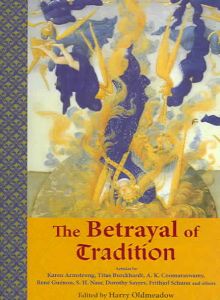
Betrayal of Tradition

The Betrayal of Tradition

Essays on the Spiritual Crisis 
of Modernity 

Harry Oldmeadow 

The Betrayal of Tradition is an anthology of essays which excavate the deepest roots of the spiritual crisis of modernity. It is controlled by several large themes: the loss of traditional metaphysical and cosmological principles which have been replaced by the pseudo-mythologies of modernity; the erosion of traditional religious and social forms; the triumph of a profane and materialistic scientism.


Some of the essays are primarily concerned with an exposition of traditional principles which are contrasted with the prevailing ideas, assumptions and values of modernity, while others focus on particular problems and issues which are of immediate and urgent concern to thoughtful people everywhere—the desacralisation of work, the global ecological crisis and the destruction of indigenous cultures, for example. All of the essays in the anthology are informed by the sense, that the most pressing problems in the contemporary world are, in one way or another, related to "the betrayal of tradition", which is to say the loss of a living understanding of those principles and values which governed the traditional civilizations of both East and West.

Bron: World Wisdom

En zie: Video

The Fullness of God

The Fullness of God
Frithjof Schuon on Christianity

Selected and edited by James S. Cutsinger

The Fullness of God is the first in a new series of titles featuring the essential writings of Frithjof Schuon. Here for the first time in one volume are the most important of Schuon’s chapters on the Christian tradition. The book is edited by James Cutsinger, Antoine Faivre contributed a foreword.


The Fullness of God has been organized in such a way as to guide the reader from matters of metaphysical principle, through various theological and hermeneutical issues, to “operative” questions of spiritual practice and method.

Specific topics include the relationship between Christianity and non-Christian religions; the divergence within Christianity between its main branches, Orthodox, Catholic, and Protestant; the place of reason and faith and their connection to spiritual knowledge or gnosis; the principles and applications of a mystical exegesis of Scripture; the central dogmas of the Trinity and Incarnation, as well as Eucharistic and Marian doctrine; and Christian initiation, contemplative practice, and “prayer of the heart”.

World Wisdom

Ye Shall Know the Truth

Ye Shall Know the Truth 
Christianity and the Perennial Philosophy 

Edited by Mateus Soares de Azevedo 
Foreword by William Stoddart 

This collection of essays by aims at explaining, discussing, and developing in a new key, the spiritual, philosophical and artistic patrimony of the Christian tradition in its intellectually challenging dimension - as well as to consider its future possibilities. Behind the book lies the belief that one of the main factors responsible for the contemporary decadence, lack of vigor, and indeed the tragic crisis, of traditional religion is the indifference that is shown towards its sapiential or “knowledge” dimension.


The essays here envisage religion primarily as knowledge of a sacred character - not as “social service” nor as a merely ethical system. The authors of the Perennial Philosophy here support the vision that the intellective dimension is central to the human being; knowledge, profoundly understood, is the very heart of man.

World Wisdom

Sufism: Love and Wisdom

Sufism: Love and Wisdom

Edited by Jean-Louis Michon 
and Roger Gaetani
Foreword by Seyyed Hossein Nasr

These essays by such contemporary writers on Sufism as Seyyed Hossein Nasr, William Chittick, Titus Burckhardt, Martin Lings, René Guénon, and Frithjof Schuon, unlock for modern readers some of the language, the thinking, and the history of classical Sufism. Covering a wide range of topics related to Sufism, the book also includes several essays translated into English for the first time and some contributions from a new generation of interpreters of Sufism.

World Wisdom


From the Introduction:

The Doctrine of Unity (Tawḥīd)

The dominant theme of the Quranic Revelation, divine Unity, is expressed by the testimony of faith—shahāda—which every Muslim repeats a number of times every day when performing the five canonical prayers and which he hopes to be able to utter at the moment of his death: “There is no god if not God (Allāh); Muhammad is the Envoy of God.” The two formulas composing this testimony are strictly complementary: the first one proclaims the dogma of absolute monotheism (tawḥīd) and concerns only the transcendent Principle, whereas the second one introduces the Envoy, bearer of the heavenly Message, a link between the Principle and manifestation. Proclaimed as the first of the five pillars of Islam, the shahāda is comparable to the apex of a pyramid whose basis would rest upon the four other ritual obligations (i.e., the five daily prayers, the fast of Ramadan, required almsgiving, and the pilgrimage to Mecca). It represents the emblem, the specific identification mark of the Islamic religion in its outer as well as inner forms and contents, and it constitutes a most frequent leitmotif and reference point in the commentaries of the theological and legal scholars, as well as in the inspired works of
the Sufi masters.